Facing Facts: India’s Organised Jewellery Sector: Strong Q2 Performance Amid Headwinds
By Debajit Saha
Research Lead, Metals, London Stock Exchange Group
India’s organised (branded) jewellery sector delivered a robust performance in the recently concluded Q2, despite facing multiple macroeconomic and policy-related challenges. Key headwinds included higher import duty on gold, the Prime Minister’s appeal to moderate gold consumption, elevated crude oil prices, and ongoing geopolitical tensions in the Middle East. Nevertheless, the sector demonstrated notable resilience, supported by favourable pricing trends and evolving consumer preferences.
Leading branded jewellery retailers, including Tanishq (Titan) and Kalyan Jewellers, reported strong growth in both revenue and profitability. This performance signals a structural shift in consumer behaviour, with increasing preference for organised players over traditional, single-store jewellers. Factors such as enhanced product transparency, assured quality, better design offerings, and an improved retail experience continue to drive this transition.
Gold Price Correction
A key catalyst for demand during the quarter was a correction in gold prices, particularly around the Akshaya Tritiya festival—one of India’s most significant gold-buying occasions. The decline in prices helped stimulate consumer purchases and effectively offset policy-related constraints in the latter half of the quarter.
Titan's quarterly update underscores the strength of India's organised jewellery sector. The company's jewellery segment reported approximately 35% y-on-y growth across both plain gold and studded jewellery categories. Additionally, gold coin sales registered double-digit growth, highlighting sustained investment demand in India’s gold market, which remains the world’s second largest. This indicates that gold continues to serve not only as an adornment but also as a key financial asset for Indian consumers.
The comparable growth in studded jewellery and plain gold jewellery provides further insight into changing consumer demographics. Studded jewellery—typically made from 18-carat gold and embedded with diamonds or other precious stones—generally has a lower resale value than plain gold jewellery. Its increasing popularity suggests rising participation from higher-income and aspirational consumer segments, reflecting a shift towards discretionary and design-led purchases.
India’s gold imports in Q2 were estimated at 75 tonnes, reflecting a 21% y-o-y decline. It is difficult to quantify jewellery sales in the vast unorganised sector, despite its overall market dominance, as these players do not disclose financial data publicly. However, anecdotal evidence suggests that jewellery demand declined by more than 65% following the increase in import duties. This trend primarily indicates that ordinary Indian households are cautious and are likely waiting for more favourable price levels before returning to the market.
Shifting Trends
From a broader perspective, jewellery demand has contracted on a y-o-y basis in recent quarters, as value-oriented buyers have increasingly found bars and coins to be a more attractive proposition amid sharply rising prices. Portfolio managers are allocating to gold ETFs for diversification, and a similar trend is emerging among retail investors, driven by growing awareness—led by asset management companies—of the benefits of investing in gold ETFs, particularly their low holding costs. As a result, liquidity has been shifting from jewellery towards investment-grade products, putting pressure on jewellery demand.
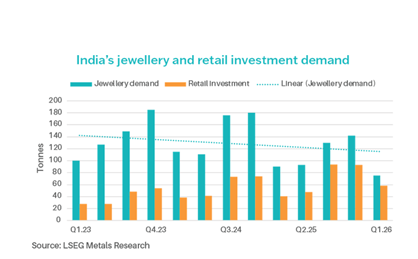
The strong performance of organised jewellers highlights their growing penetration across middle- and high-income segments. As trust, branding, and customer experience gain prominence, the organised sector is well positioned to sustain its growth trajectory, even amid an evolving economic environment.
Debajit Saha
By Debajit Saha
Research Lead, Metals, London Stock Exchange Group
Debajit is a Lead Analyst at LSEG, based in Mumbai. He is responsible for precious metals research in Asia, Middle East. He has a bachelor’s degree from the University of North Bengal, India.
Source: https://www.lbma.org.uk/