China Bought the Most Gold Since 2023 in July. Here’s Why.
Wed Aug 12 2026
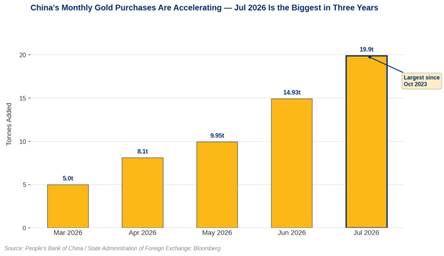
China’s central bank added 19.9 tonnes of gold in July 2026 — its largest single-month purchase since October 2023 and its 21st consecutive month of buying. The number matters. The mechanism behind it matters more.
Gold is currently trading near $4,418 per ounce, per goldsilver.com/price-charts/.
Why Did China’s Central Bank Buy This Much Gold in July?
The People’s Bank of China lifted its official gold holdings to 76.08 million troy ounces at the end of July, up from 75.44 million ounces in June. [People’s Bank of China / State Administration of Foreign Exchange, August 7, 2026.] That 640,000-ounce addition equals roughly 19.9 metric tons and represents the largest single-month increase since October 2023.
Furthermore, the pace is accelerating. The PBOC added roughly 5 tonnes in March, then progressively larger amounts through the spring. By June, the monthly figure had reached 14.93 tonnes. July’s 19.9 tonnes exceeded even that. The central bank has now added approximately 60 tonnes of gold in 2026 alone. [World Gold Council, EMEA Senior Analyst Krishan Gopaul, August 7, 2026.
The buying did not slow when prices fell. It did not pause when the Federal Reserve signaled tighter policy. Additionally, it continued through gold’s worst quarterly decline in thirteen years, when the metal fell below $4,000 for the first time since November 2025, touching an intraday low near $3,960 in late June. The July data confirms that short-term price movements are not the primary variable in this decision.
What Is Driving the Acceleration?
The answer is structural, not tactical.
China’s gold holdings represent roughly 8 percent of its total official foreign-exchange assets. [The Private Banker, August 7, 2026.] In contrast, the global central bank average sits near 27 percent, according to World Gold Council data. That 19-percentage-point gap is not a short-term positioning question. It is a multi-decade reserve management task.
Consequently, each month’s purchase is one increment in a long rebalancing program. The PBOC is not responding to the latest Fed announcement or reacting to a geopolitical headline. Instead, it is closing a structural allocation gap, one monthly tranche at a time.
This also explains why the streak has now run to 21 consecutive months — the longest documented run since at least 2015. A reserve manager operating on a ten-year or twenty-year horizon does not stop buying because inflation came in slightly above expectations or because futures markets repriced September rate-hike odds. Meanwhile, 74 percent of surveyed central banks expect the share of US dollars in global reserves to decline over the next five years. [World Gold Council, Central Bank Gold Reserves Survey 2026, 76 respondents.
What Does China’s Gold Buying Mean for the Price?
Today’s broader picture adds context. July’s consumer price index came in at 3.4 percent year-over-year, in line with consensus and below June’s 3.5 percent reading. [Bureau of Labor Statistics, August 12, 2026.] Core CPI held at 2.5 percent year-over-year. As a result, market-implied odds of a Federal Reserve rate hike in September eased from roughly 50 percent to below 50 percent, which gave gold a near-term lift. The metal briefly touched $4,438 this morning before settling near current levels.
The PBOC data and today’s CPI print are, however, working through entirely different time frames. The CPI reaction plays out over hours and days. The reserve rebalancing thesis plays out over years and decades.
In addition to the PBOC’s continued buying, gold exchange-traded funds recorded a fifth consecutive session of inflows into this morning’s data. Global gold ETF holdings reached 4,068 tonnes in July, reversing two prior months of outflows.
How Does This Streak Compare to History?
The current 21-month buying streak began in November 2024. It is the longest continuous accumulation run since at least 2015, when China first began publishing consistent monthly reserve disclosures.
In total, China has now accumulated roughly 60 tonnes of gold in 2026 alone. Over the full streak since November 2024, total official additions run above 100 tonnes. At current prices, China’s gold reserves are valued at approximately $306 billion.
Moreover, China is not alone. The World Gold Council’s 2026 Central Bank Gold Reserves Survey, conducted among 76 central banks, found that 89 percent of respondents expect global official gold reserves to increase over the next 12 months. A record 45 percent plan to add gold to their own institutions’ holdings.
What Does This Mean for Individual Savers?
The mechanism sovereign reserve managers apply at institutional scale is the same one individual savers apply at personal scale.
A central bank holding 8 percent of its reserves in gold, in a world where the global average is 27 percent, is telling you something specific: it believes its current allocation is too low and intends to correct it, regardless of where the price is on any given Tuesday.
The PBOC bought its most gold in three years this July. It did it as prices recovered toward $4,400. Similarly, it bought in June when prices had fallen below $4,000. Neither price was the variable. The structural gap was.
Accordingly, the next SAFE data release, covering August purchases, arrives in early September. PPI data for July releases tomorrow at 8:30 a.m. ET, and will be the next near-term catalyst for gold and silver pricing.
Source: https://goldsilver.com