Gold SWOT: Uganda Plans To Start Domestic Gold Purchases To Build Forex Reserves
Gold futures closed the week at $2,416.30, up $18.60 per ounce, or 0.78%. Gold stocks, as measured by the NYSE Arca Gold Miners Index, ended the week higher by 5.73%. The S&P/TSX Venture Index came in up 1.36%. The U.S. Trade-Weighted Dollar fell 0.75%.
Strengths
- The best performing precious metal for the week was
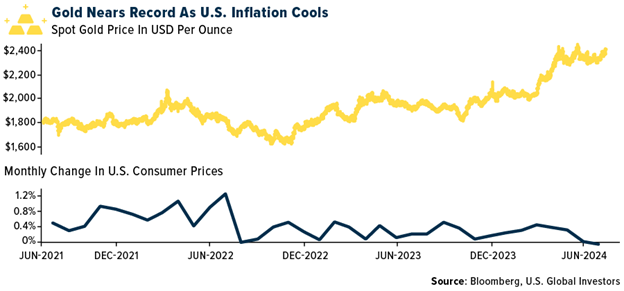
gold, up 0.78% after lagging the other precious metals last week. Uganda
announced plans to start domestic gold purchases to build foreign exchange
reserves. Purchases will be executed by the Bank of Uganda directly with
artisanal miners. Both the central banks of Nigeria and Zimbabwe have
enacted such programs. Gold jumped above $2,400 an ounce to close in
on the record price set in May, after an unexpected drop in U.S. consumer
prices bolstered hopes that the Federal Reserve will soon start cutting
interest rates. Gold jumped as much as 1.8% after data from the Bureau of
Labor Statistics showed a 0.1% monthly decline in consumer prices, marking
the first negative reading in more than four years, according to
Bloomberg.
- Osisko Gold Royalties reported preliminary revenue for the
second quarter that beat the average analyst estimate. Preliminary revenue
is C$64.8 million, compared to an estimate of C$59 million, according to
Bloomberg.
- Wesdome Gold Mines reported record quarterly production of
44,035 ounces, well above BMO’s estimate of 35,000, as for the first time
both company’s mines mined meaningful tons of high-grade mineralization.
After several years of development, the Kiena
mine is now able to process high-grade Deep A zone mineralization.
Weaknesses
- The worst performing precious metal for the week was
palladium, down 6.60%, essentially giving up the prior week’s gain.
According to Goldman, over the past 12 months, the Australian gold sector
has returned to cash generation over absolute production growth. However,
Australian gold equities have recently broadly underperformed the
Australian gold price. They expect this is at least in part driven by
continued cost escalation, where over the last 5 years all-in-sustaining
costs (AISCs) are up 40% on average, reducing the pass through to margin
expansion.
- Endeavour Silver reported preliminary silver production
for the second quarter that missed the average analyst’s estimate.
Preliminary silver production was 1.31 million ounces, which was below the
estimate 1.38 million, according to Bloomberg.
- Sibanye-Stillwater experienced a cyber-attack that is
affecting its IT systems globally. While the investigation into the
incident is ongoing, there has been limited disruption to the Group's
operations globally, according to Bloomberg.
Opportunities
- Calibre Mining announced that it has received key
environmental permits necessary for the development of open pit mines at the
Volcan gold deposit in Nicaragua, located 5
kilometers south of the Libertad mill, according to Scotia.
- Central banks have been the most notable buyers of gold
in recent years, particularly in the last three years. However, both
retail and professional investors have been in liquidation mode regarding
the SPDR Gold Shares ETF, a proxy for bullion, since 2020. That trend
appears to have come to an end in the first half of March 2024, with 282.9
million shares outstanding. Since then, the shares outstanding have
climbed to 292.2 million, with new shares being created as new money has
finally started to flow back into gold.
- According to Stifel, G2 Goldfields represents the most
exciting exploration-driven story they cover, with exploration success
directly impacting share price performance. They highlight the discovery
of 300,000 ounces of underground gold at 4.56 grams per ton already
drilled at Ghanie, and they anticipate further
drilling will yield similar results.
Threats
- According to Morgan Stanley, silver price-driven demand
destruction may emerge. Silver jewelry demand already fell 13% in 2023,
mainly driven by India. Solar demand could slow more significantly due to
grid constraints, overcapacity, and poor margins. Additionally, high
prices may encourage thrifting, with silver accounting for 11% of current
solar module costs. Silver prices could also decline if rate cuts are
implemented in response to economic weakness, which would weigh on
industrial demand.
- Companies that buy metal sourced from central Africa
could expose themselves to United Nations sanctions for supporting warfare
in eastern Democratic Republic of Congo, according to a report by UN
experts. Congo’s trade in gold, tin and tantalum—key minerals in portable
electronics—is directly supporting armed groups involved in widespread
human rights abuses and fueling one of the world’s deadliest conflicts, as
reported by Bloomberg.
- Platinum jewelry demand is weakening. China's demand
for platinum jewelry is now less than half of what it was in 2013 and
declined further last year amid competition from gold, according to BMO.
Source: https://www.gold-eagle.com/